- Edition
- First
- Date
- April 2022
- Venue
- Kothari Hall, Bangalore
- Running time
- 1:09:32
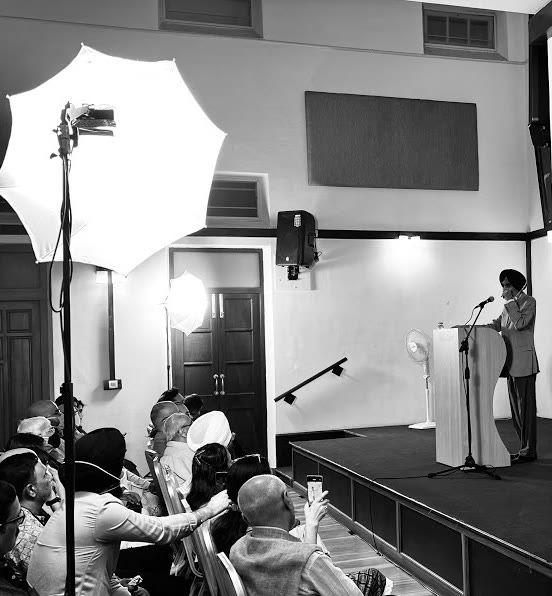
Recorded live at Kothari HallWatch on YouTube ↗
The lecture
The first lecture began close to home. Chiranjiv Singh, himself a refugee child of 1947 like Ravi Sondhi, traced how the Partition reached a city a thousand miles from the new borders. He described the few thousand Sindhis and Punjabis met at the railway station by the Punjabi Sabha, settling near the Cantonment gurdwara and in Cox Town, and helped quietly by the Maharaja’s government. Partition’s larger legacy, he argued, came indirectly. It sent India’s great public-sector companies south, and with them the migrations that remade Bangalore. He moved from the Cantonment and the Pete, the two cultures of the city, to its vanished lakes and the politics of language. It was a humane, far-reaching talk, and it ended on a plain truth: memories endure.
In six movements
What was said
A partition of Punjab and Bengal
Singh opened with Punjabi verse and the vast human cost of 1947: some 600,000 dead and 14 million uprooted. He drew on Ismat Chughtai, Ashis Nandy and the psychiatrists of NIMHANS to describe a trauma that outlived the event.
Arrivals in a gentle city
Around 8,000 refugees came to Karnataka, most of them Sindhis and most settling in Bangalore. The Punjabi Sabha, founded in 1936, met the trains with stoves, provisions and clothes. The Maharaja’s government offered land, loans and a Commissioner for Rehabilitation.
The Cantonment as a home for outsiders
Sikhs settled near the 1943 gurdwara and Sindhis built the Sindhi Colony in Cox Town. Many newcomers learned Tamil rather than Kannada, the language of the Cantonment’s streets. They went into textiles, transport, spare parts and sports goods.
The two-headed city
The Gandabherunda, Karnataka’s two-headed bird, became Singh’s metaphor for Bangalore. One head was the Cantonment, ruled from Madras and steeped in colonial culture. The other was the Pete and Basavanagudi, shaped by the courtly culture of Mysore.
The indirect legacy
Partition moved India’s centre south, and strategic industries followed it to Bangalore, far from hostile borders. Their townships, drama clubs and Kannada sanghas brought the city’s great migration, and the IT wave came after. “Culture trumps economics,” he said.
Lakes, ridges and planners
Bangalore was once a city of some 400 tanks. Singh turned to Patrick Geddes and Jane Jacobs to ask who the city is for. The refugees, he observed, carried with them the memory of the walkable cities they had lost.
In their words
“Ravi Sondhiji was a child of Partition… He is one of those who made Bangalore Bangalore.”
“Communalism is seldom one-sided. It feeds on the other.”
“The refugees carried the memories of those places. Memories endure.”
The speaker
Chiranjiv Singh joined the IAS in 1969 and retired in 2005 as Development Commissioner and Additional Chief Secretary of Karnataka. He served as India’s Ambassador to UNESCO in Paris, was a Visiting Fellow at Queen Elizabeth House, Oxford, and presided over the Alliance Française de Bangalore from 2005 to 2017. He holds the Karnataka Rajyotsava Award and was made a Chevalier de l’Ordre national du Mérite by the President of France. Like Ravi Sondhi, he came to the city as a child of Partition.